Anthropic's 200-Million-Conversation Distillation Accusations Against Seven Chinese AI Labs
In 2026, 'distillation' has become the most sensitive technical term in the US-China AI rivalry.
On February 23, Anthropic posted a blog naming DeepSeek, Moonshot, and MiniMax, claiming that through approximately 24,000 fraudulent accounts they conducted over 16 million conversations with Claude, 'illegally extracting' Claude's capabilities. On September 10, Anthropic published another threat intelligence report, expanding the list to seven China-based AI labs, covering Alibaba, DeepSeek, Moonshot, Zhipu, Xiaomi, SenseTime, and MiniMax, with cumulative conversations said to be close to 200 million.
A premise needs to be clearly stated: all these numbers come from Anthropic's unilateral attribution, the evidence details have not been made public, and most accused parties either deny or decline to comment. This article does not presume guilt; rather, it explains three things: the complete timeline of events and statements from all sides, what model distillation technology actually is, and the legal gray zone behind this offensive-defensive battle.

I. Timeline of events: from three to seven companies, three reports escalating
First report (2026-02-23): three 'AI Tigers' named
In 'Detecting and preventing distillation attacks', Anthropic disclosed that its security team identified three industrial-scale distillation attacks, all pointing to Chinese labs: DeepSeek, Moonshot, and MiniMax. The report's quantified figures: approximately 24,000 fraudulent accounts and over 16 million conversation exchanges, among which MiniMax had about 13 million, Moonshot about 3.4 million, and DeepSeek over 150,000.

The report also emphasizes a distinction that is often overlooked: distillation itself is a legal and widely used training method. Frontier labs routinely distill their own models to produce smaller, cheaper versions. What Anthropic objects to is 'illegal distillation' that violates terms of service and regional access restrictions.
Second report (2026-09-10): list expands to seven
The September threat intelligence report widened the scope of accusations. The report states: since the first disclosure in February, Anthropic has identified and blocked distillation attacks against Claude from seven China-based labs. The targets were all publicly available models, with no attempts on unreleased models. On September 8, the NSA, CISA, and FBI issued a joint advisory on this matter.

Based on the report and public accounts, the accusations against the seven named parties are as follows (all are Anthropic's unilateral claims, not independently verified):
| Accused party | Models/Products | Anthropic's claimed scale and method |
|---|---|---|
| Alibaba (Qwen) | Qwen 3.5/3.6/3.7 | 151 million conversations from May to July, peaking at 3 million per day, 3500+ fraudulent accounts; used fixed prompts to force chain-of-thought output, then SFT |
| Moonshot (Kimi) | Kimi series | About 23 million conversations; accused of secretly forwarding user requests to Claude, operating 5380 fraudulent accounts in Singapore, Japan, etc. |
| DeepSeek | DeepSeek series | About 12.1 million in 14 days in July; accused of routing user traffic to Claude Opus via Claude Code, Agent SDK, OpenCode, etc. |
| Zhipu (Z.ai/GLM) | GLM series | 17 days from June to July, about 3.4 million, 273 accounts; accused of building a chain-of-thought 'cleaning pipeline' for training |
| Xiaomi (MiMo) | MiMo | 20 days from March to April, about 400,000; accused of replaying its own user session data for SFT and reinforcement learning |
| SenseTime | — | Specific count not disclosed; accused of purchasing distillation data via third-party data suppliers |
| MiniMax | — | Specific count not disclosed; accused of running a shell-company proxy site that offered only Anthropic and OpenAI interfaces |
The report also outlines three techniques used to induce Claude to output full reasoning: direct command requests, disguised as katakana Japanese translation tasks, and cross-session replay of thinking signatures. Anthropic says it validated these techniques with 12,000 test requests.
Third report (2026-10-12): defense effectiveness and costs
The October 'Strengthening our defenses against distillation attacks' turned to the defense side. Key figures: new methods reduce the amount of data a distiller can harvest by approximately 90% to 99%, and stolen reasoning tokens drop by 10 to 100 times.

Responses from accused parties and regulators
After the accusations, public corporate responses have been rather restrained. According to a February report by Jiemian News, DeepSeek, MiniMax, and Moonshot all 'had no response' at the time. The report also mentioned that Moonshot CEO Yang Zhilin previously denied that K2.5 had been distilled from Claude. Later, Moonshot Vice President Huang Zhenxin stated that Kimi K3's capabilities come from underlying original architectural innovation and domestic compute cluster training, with training data sourced from publicly compliant channels. A common industry view is that deploying open-source models on servers and calling them automatically is common practice, and API call patterns alone are insufficient to prove distillation.

The Chinese government has explicitly rejected the accusation. Ministry of Commerce spokesperson He Yongqian called it 'lacking factual basis and legal support', a 'double standard' and 'AI hegemony'. The Ministry of Foreign Affairs made similar statements at a regular press conference in July. A commentary published on China.com ran the headline directly: 'If you can't win, smear: can the US use "distillation" as a pretext to contain China's AI and succeed?'

As of this article's publication (November 23, 2026), there has been no public judicial litigation filed by any party; the dispute remains at the level of public opinion and policy.
II. Technical principles: what exactly does distillation 'steam'?
Starting from Hinton's soft labels
The concept of knowledge distillation dates back to the 2015 paper 'Distilling the Knowledge in a Neural Network' by Geoffrey Hinton and others [6]. In the classic setup, there is a large, strong 'teacher model' and a small, lightweight 'student model'. The teacher outputs not just hard labels (e.g., 'this is a cat') but soft labels with a temperature coefficient—a probability distribution (e.g., 'cat 70%, dog 20%, fox 10%'). Soft labels encode the teacher's judgment about class similarities, and the student uses KL divergence to align with this distribution, thereby learning the teacher's generalization ability with much fewer parameters.
This is white-box distillation: you need access to the teacher's logits (output log-probabilities) or weights, typically happening within the same company, and fully legal.
Four paths in the black-box era
The problem is that closed APIs like Claude only return text, not logits. As a result, real-world 'stealing' has shifted to black-box paths.

- Response data distillation (most common): Batch constructs prompts to call the teacher API and directly uses the returned answers as SFT (supervised fine-tuning) material for a student model. This has the lowest barrier—only API access is needed. Anthropic's accusation that Alibaba used fixed prompts to force chain-of-thought from Claude and then trained on it falls into this category.
- Chain-of-thought distillation (most valuable): Learning only answers teaches you 'what to say'; learning the reasoning process teaches you 'how to think'. Inducing the teacher to write out complete CoT and using that as training data yields ability gains that transfer across tasks. This is why all three induction techniques in the accusation focus on obtaining reasoning processes. Scholarly work such as Orca in 2023 has verified that CoT distillation gives small models significant gains on complex reasoning benchmarks.
- Preference and reward distillation (RLAIF): Rather than having the teacher write answers directly, it is asked to score and rank multiple candidate responses, or act as a reward model outputting rubric scores, and these preference signals are then used for the student's reinforcement learning. Anthropic's report states that DeepSeek's rubric grading tasks fall into this category.
- Model extraction attacks: A more academic direction, first systematically proposed by Tramèr et al. in 2016 [7], reconstructs a model's decision boundary or even approximate parameters through many queries—a classic model for black-box attack research.
Why is distillation effective? Because the student imitates the teacher's input-output mapping relationship, not the weights themselves. But this also brings a key characteristic: capabilities transfer, but safety guardrails do not. The refusal strategies, value alignment, and safety behavior trained into the teacher via RLHF do not fully replicate to the student through output data. This is one of the safety risks regulators are concerned about.
III. Attack-defense chain: a cost-asymmetric cat-and-mouse game
Putting the three reports together reveals a complete attack-defense loop.
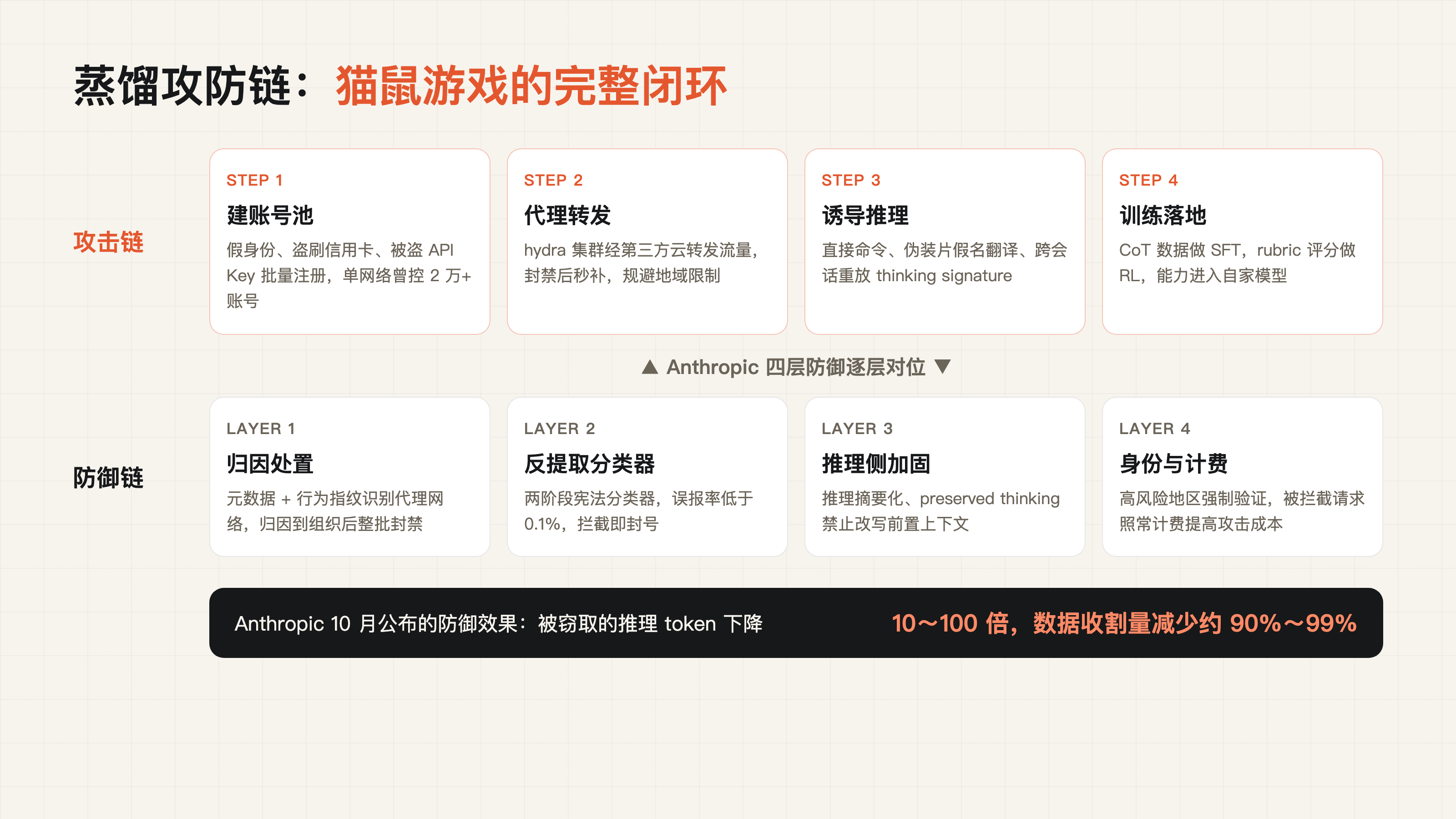
Attack side four steps: First, batch-create account pools using fake identities, stolen credit cards, or stolen API keys (a single network is accused of controlling 20,000+ accounts). Then route traffic through hydra proxy clusters on third-party clouds, blocking one and making another. Next, induce reasoning output using direct commands, disguised translations, or replayed thinking signatures. Finally, use the CoT data for SFT and scoring data for RL, accumulating capabilities into the attacker's own model.
Anthropic's four layers of defense answer each step:
- Attribution and takedown: Uses metadata and behavioral fingerprints to identify proxy networks, attributes to the organization, and batch-bans, cumulatively banning tens of thousands of accounts.
- Anti-extraction classifiers: A two-stage constitutional classifier identifies distillation intent in real time, with false positive rate kept below 0.1%, and accounts are banned upon detection.
- Inference-side hardening: For high-risk requests, returns reasoning summaries instead of full chain-of-thought, and activates 'preserved thinking' in models like Fable 5.1 and Opus 5.5, forbidding rewriting of the thinking content in preceding context.
- Identity and billing: Mandates identity verification in high-risk regions, and since September 24, continues to bill for blocked requests, directly raising the attack cost.
Defense comes at a price. Anthropic itself published a set of honest numbers: reasoning summarization drops the model's SWE-bench score from 80.4% to 71.8%, effectively trading about 8.6 percentage points of task performance for anti-distillation capability. This explains why platforms cannot simply 'hide all chain-of-thought'—there is a real trade-off between security and product capability.
IV. Core disputes: three unresolved questions
1. How far can attribution evidence go?
Anthropic's evidence chain rests on account metadata, IP/payment fingerprints, traffic behavior patterns, and 12,000 test requests, not public weight comparisons. Behavioral attribution can support platform banning decisions, but proving in court that 'this model is a distillation product of that model' is a completely different standard—model training processes are opaque, and similar capabilities can also arise from similar data and architecture. When accused parties deny, external third parties have no way to independently verify either side's claims.
2. What law does training a model on API output violate?
This is the core legal gray zone. Violating platform terms of service (ToS) is first a contract breach. But whether API output text itself constitutes a copyrighted work, and whether bulk scraping violates copyright, is still dividing courts across countries. Trade secret protection requires that information possess confidentiality and that reasonable measures are taken to maintain it; whether publicly accessible API outputs meet that requirement is contested. The US CFAA (Computer Fraud and Abuse Act) has been narrowing in recent case law on the interpretation that 'violating ToS is a crime'. In other words, Anthropic's strongest legal lever is contract, not intellectual property.
3. Could distillation bans in turn constrain American companies themselves?
Distillation is a common industry-wide technique: open-source model licenses generally permit or even encourage distillation, and Chinese vendors' open-source models can be distilled by anyone. Reports have also surfaced of US companies being accused of distilling open-source models. If 'calling an API to train a competitor' is made fully illegal, the constraint will be bilateral—which is the source of the 'double standard' critique. Under the guise of technological neutrality, the real contest is: whoever defines the rules of model capability flow will control the division of labor in the next generation of AI industry.
V. Three practical suggestions for developers and teams
- Treat ToS compliance as a supply-chain issue. Before fine-tuning on data produced by third-party large-model APIs, read the terms regarding 'using outputs to train competitors' and retain provenance records. Contractual risk does not disappear because something is technically feasible.
- For self-hosted models, prefer white-box and open-source distillation. Distilling between large and small models within your own model family, or doing SFT based on open-source models with clear licenses (Llama, Qwen, DeepSeek, etc.), is currently the route with the highest legal certainty.
- If you are a model provider, do the cost accounting for defense: summarization, classifiers, and identity verification each carry performance and false-positive costs. Refer to Anthropic's public data; start with account risk control and anomaly traffic detection, then gradually add inference-side hardening.
References
[1] Anthropic. Detecting and preventing distillation attacks (2026-02-23) [2] Anthropic. Threat Intelligence Report: September 2026 (2026-09-10) [3] Anthropic. Strengthening our defenses against distillation attacks (2026-10-12) [4] Jiemian News. DeepSeek, Moonshot, MiniMax named for 'illegal extraction', did they do wrong? [5] China.com·Focus on China. If you can't win, smear: can the US use 'distillation' as a pretext to contain China's AI and succeed? [6] Hinton G., et al. Distilling the Knowledge in a Neural Network (arXiv:1503.02531, 2015) [7] Tramèr F., et al. Stealing Machine Learning Models via Prediction APIs (USENIX Security 2016)
Note: The accusation data for the seven companies cited in this article all come from Anthropic's public reports and media accounts, and are unilateral statements. The screenshots in the article were taken from the corresponding web pages and belong to their original copyright holders. Similarity of model capabilities does not equal legal facts of distillation; readers should exercise independent judgment based on multiple sources.
Top 1 from juejin.cn, machine-translated. The original thread is authoritative.
[无辜呆]