DeepSeek's $15B Oversubscribed Round: Same Price, More Shares, No Voting Rights
Six Months After Saying It Didn't Need Money, a $15 Billion Oversubscription
Liang Wenfeng had just closed a 51 billion yuan first round in June, with 20 billion yuan of his own money, and had also said "DeepSeek doesn't need money."
From 50 billion to 100 billion: the two upsizings were not broken negotiations, they were subscription overflow
The 500-to-800-to-1000 upsize timeline
The target doubled in two months
Eighteen months ago, DeepSeek was still denying that "any financing-related reports are rumors," and Liang Wenfeng publicly said there was no short-term financing plan. Six months later, the first round closed at 51 billion yuan, and immediately after, the second-round target went up to 100 billion. The turning point was not the market educating the company; it was the company's own compute gap compressing the timetable. In the first round, investor funds went into a limited partnership managed by Liang Wenfeng, and investors have no voting rights. That structure carried over into the second round.
The pace of the upsizing shows how fast subscriptions came in. Bloomberg reconstructed the full sequence on October 22: the round's original target was 50 billion yuan; during the roadshow, subscriptions exceeded expectations, and the company proactively raised the target to 80 billion; after a second increase, it settled at about 100 billion yuan. The two increases were less than a week apart. Breaking it down: in the June first round, Liang Wenfeng personally put in 20 billion yuan, Tencent 10 billion, the CATL system 5 billion, and NetEase and JD each participated. In mid-July, the Financial Times reported preliminary talks for a new round with a pre-money valuation of about $71 billion. On October 6, Bloomberg confirmed a target of at least 80 billion yuan; on October 22, it confirmed the final figure was approaching 100 billion, with the deal completed within days.

DeepSeek's second-round financing upsize
One detail is easy to miss. The pre-money valuation has stayed locked at about 500 billion yuan (about $74.8 billion) before and after the target doubled. New money bought a larger share of the company at the same price. This is not a premium round; it is front-running.
Who is pushing the round up: the screening of industrial capital vs. financial investors
The main force behind the subscription overflow is not financial funds; it is industrial capital. CATL has committed about $1.5 billion this round, twice its 5 billion yuan in the first round. Once finalized, it could become the largest external investor, though still behind Liang Wenfeng's personal 20 billion yuan. Tencent is tied for the largest contribution. Geely, Monolith Management, and Loyal Valley Capital have committed. New entrants include Shixi Capital, SMIC Juyuan, CPE Yuanfeng, Legend Capital, and Boyu Capital, and Hefei's state-owned investment platform is also on the negotiation list.
The screening criteria are clear. CNBC, citing people familiar with the matter, reported that DeepSeek declined private capital from individual investors and focused on state-backed funds and the industrial capital of listed companies. This round does not want LPs who can only put up money; it wants counterparties who, after putting up money, can also bring in compute, chips, and manufacturing lines. The logic: CATL raising to $1.5 billion means its battery production lines need to be tied to next-generation AI dispatch; Tencent's increase means its cloud services and inference layer will run on a domestic model. Industrial capital is not entering for financial returns; it is entering to hang its own business on this engine.
This structure is being completed before an IPO window in early 2027. Bloomberg reported that after the financing is completed, the company will restructure to prepare for a STAR Market listing. New and existing shareholders are each expected to contribute about half of the round. Once the last batch of same-price admission tickets before the listing is handed out, the next round will not be priced at this number.
Liang Wenfeng had just closed the 51 billion yuan first round in June, personally putting up 20 billion yuan, and had said "DeepSeek doesn't need money."
CATL's $1.5 billion and Tencent's stake structure
The pre-money valuation did not move. Chinese media put the figure at $74.8 billion (about 500 billion yuan), unchanged from before the round doubled. New shareholders get a larger stake at the same price. This is not a premium; it is front-running.
CATL has committed about 15 billion yuan ($1.5 billion), twice its 5 billion yuan in the first round. Tencent put in 10 billion yuan in the first round and is adding more this round. Together, the two account for the absolute majority of the round. The use of funds is written into the terms: model training, compute construction, and paving the way for the early-2027 STAR Market IPO.
Division of labor: existing shareholders adding vs. new industrial capital
This round, new and existing shareholders are each expected to contribute about half. Existing shareholders: Tencent, CATL, IDG Capital, Lisi Capital, Shixiang Capital, and Zhengxingu Investment. New entrants: Shixi Capital, SMIC Juyuan, CPE Yuanfeng, Legend Capital, and Geely.
The division logic can be broken down. Industrial capital (CATL for compute and battery supply chains, Geely for autonomous-driving scenarios, SMIC Juyuan for chip manufacturing) brings application scenarios and upstream/downstream ties, not pure financial-return expectations. IDG and Lisi were the financial-investor leg of the first round, and their increase this round is more about locking in and holding. What is harsher is that at this scale, people are still being screened. A normal private round at the hundred-billion level accepts everyone, but Liang Wenfeng only accepts institutional industrial capital and has declined all subscription applications from individual investors and private funds. He does not need financial investors' votes; he needs compute and data scenarios.
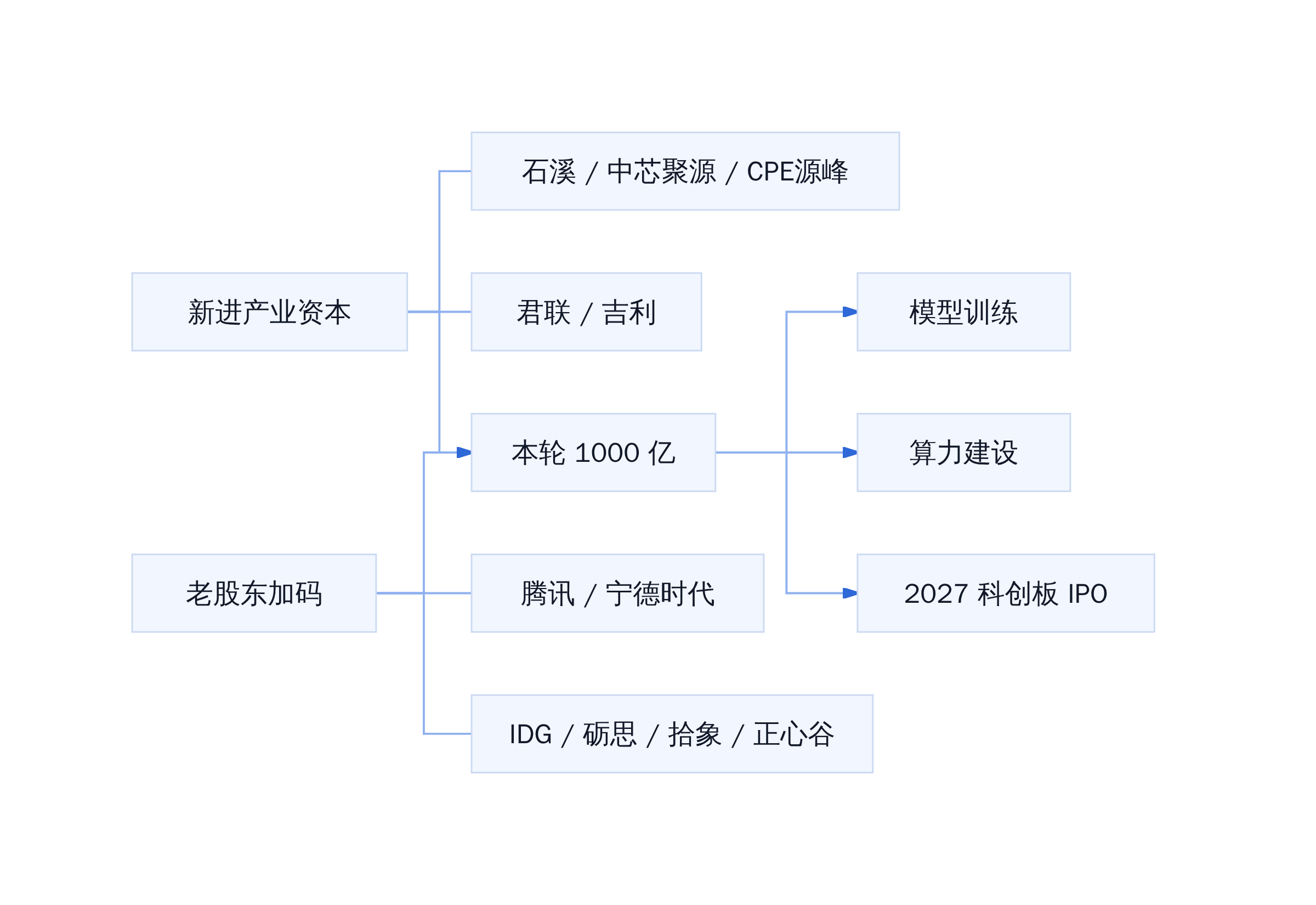
This round's stake structure and capital flows
Liang Wenfeng's 20 billion personal contribution and the limited-partnership voting design
In the 51 billion yuan first round, Liang Wenfeng personally contributed 20 billion yuan. That money, like all investor funds, went into the limited partnership he manages. The terms are hard: investors do not have voting rights.
The effect is clear. Once the 100 billion yuan is in place, Tencent's 10 billion, CATL's 15 billion, and the stakes of Shixi and Geely all become pure economic interests. Model direction, compute allocation, team expansion, and IPO timing: voting power still concentrates in Liang Wenfeng alone. Structurally, this is more extreme than Google's dual-class shares. At least Google's Class B shares have voting rights; these LP interests do not even have observation rights.
The problem is the IPO. A STAR Market listing requires a clear equity structure and equal rights and obligations for shareholders. The "contribute capital but no voting" design of the limited partnership must be dismantled or restructured before the listing. The Bloomberg line that "the company will restructure after the financing is completed" is about taking apart this shell. The early-2027 window leaves less than a year for restructuring tests and compliance review.
One-line conclusion: under the STAR Market compliance framework, the "no-vote" limited partnership can only be a pre-IPO transition, not a final structure. This 100 billion yuan round is the last private placement before the IPO; after that, the equity structure has to move toward public-company standards.
Pre-money locked at 500 billion: more money, price unchanged
The pre-money valuation is about $74.8 billion (500 billion yuan). It did not rise while the raise went from 50 billion yuan to 100 billion yuan (Bloomberg, October 22, 2026). New shareholders receive a larger block at the same per-share price. Pre-money unchanged, raise doubled, new shareholders get a bigger stake at the same price. This is not a premium; it is front-running.
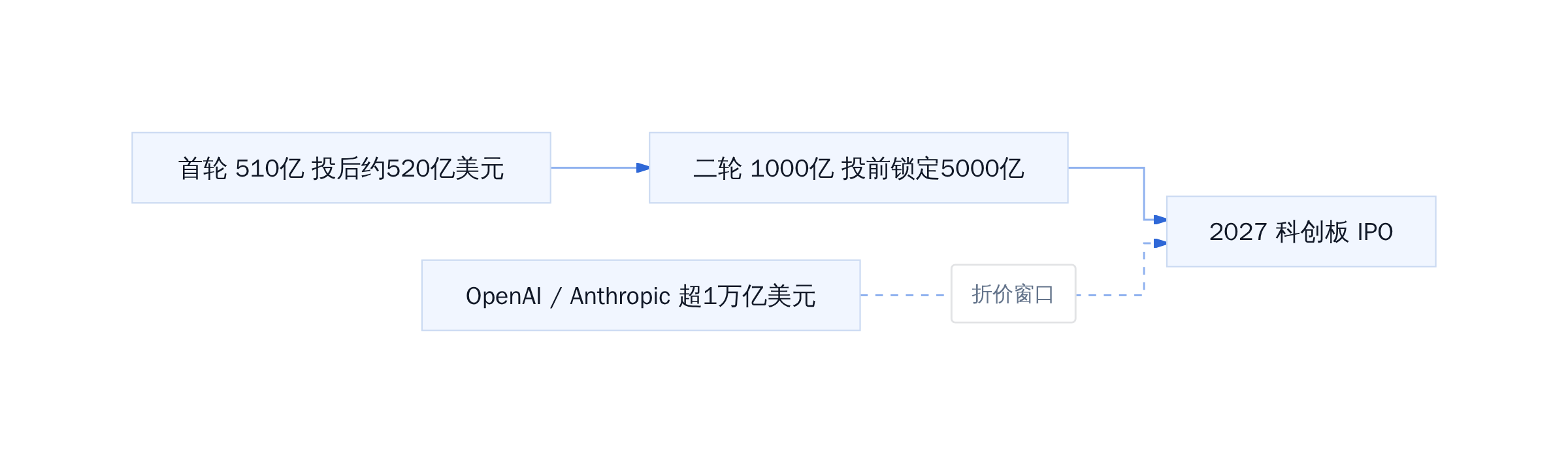
DeepSeek valuation path and international comparison
What a larger stake at the same price means
CATL's total of 15 billion yuan and Tencent's movement toward 20 billion yuan are all anchored to a 500 billion yuan pre-money. The share expanded; the price did not move. For industrial capital, this is not betting on the valuation rising another notch; it is sitting firm before the STAR Market listing price is hammered down. Once the discount window closes, the paper gains on these stakes are locked.
Comparison window with OpenAI / Anthropic's trillion-dollar valuations
OpenAI's and Anthropic's 2026 private valuations have both passed $1 trillion. DeepSeek's pre-money is $74.8 billion, a gap of about $25 billion to $30 billion. If the STAR Market IPO pricing refers to the valuation band of international peers, the current 500 billion yuan pre-money gives new industrial investors a discount cushion; for financial investors, this round is most likely the last batch of private shares before the listing.
2027 STAR Market IPO: stepping stone or bet
Use of funds: compute, next-generation models, talent
Bloomberg and Reuters reports are consistent: the money goes mainly to model training, compute infrastructure construction, and talent recruitment. The more important line is "the company will restructure after the financing is completed." That is not an administrative procedure; it is a compliance adjustment of the equity structure and governance framework for a STAR Market IPO. The STAR Market has hard requirements on quantified technology attributes and R&D spending ratios. As an AI company in a high-capital-expenditure phase, DeepSeek needs to reclassify compute spending from "burning money" into a "fixed assets" line before filing. Pre-money locked at 500 billion yuan, raise doubled but price unchanged, new shareholders get a larger stake at the same price. This is not a premium; it is front-running.
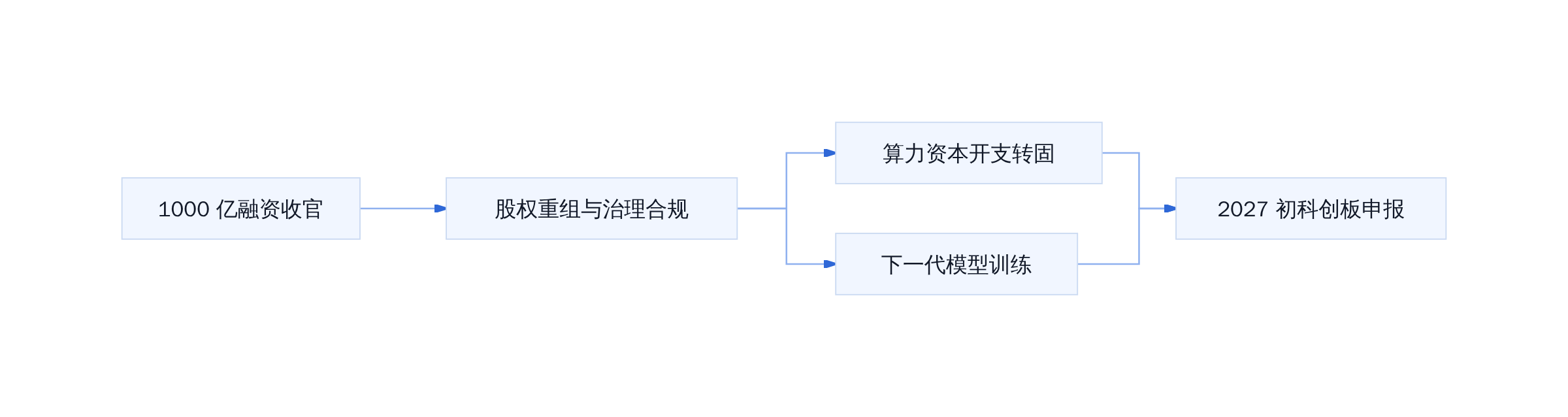
DeepSeek's 2027 STAR Market filing path
Eighteen months ago it was denying financing; six months later it is oversubscribed and has doubled the round. DeepSeek's speed means it is already restructuring while competitors have yet to finish reading the prospectus.
The low-key strategy after the roadshow recording leaked
21st Century Business Herald, citing sources, put it bluntly: the first round's public reaction was too intense, and leaked roadshow recordings and minutes triggered market discussion. "This time, the company and Liang Wenfeng want to complete this round more quietly." In action: as of October 22, DeepSeek and Tencent had both issued no press release, held no signing ceremony, and had no news publication. A company that raised a combined $22.5 billion in two rounds in six months is communicating externally about the same as a project that raised 1 billion yuan.
Questions this round has not answered
Unannounced, unanswered, final amount undetermined
Shanghai Securities News' wording on October 22 was "plans to raise" and "the deal is expected to be formally completed in the coming days." The words "plans" and "expected" remove all certainty. Whether the final amount really lands at 100 billion yuan, whether CATL is really $1.5 billion, and what Tencent actually contributes have no signed public documents to verify. The post-money dilution ratio and whether existing shareholders are following up in proportion remain at the level of "people close to the company."
An industry signal of accelerated funding pace among Chinese AI companies
Looking at the full timeline: in July, Zhipu raised HK$31.375 billion in a Hong Kong placement; in September, it launched another HK$39.3 billion placement plus convertible bonds, setting a new record for cumulative Chinese AI financing in three months. In the same period, DeepSeek raised about $22.5 billion across two rounds. In the US, OpenAI and Anthropic have broken the $1 trillion valuation mark, with IPO talk approaching $2 trillion. The narrative for Chinese large-model companies has switched from "can they survive 18 months" to "when will they go before the review committee," and the overall capital tempo has moved forward.
But one boundary must be stated clearly: the STAR Market has hard review thresholds for sustained profitability and R&D spending ratios, and AI companies are generally still in a loss-making period. Whether this is a stepping stone or a bet depends on whether the accounting treatment of compute capitalization passes review when the 2027 filing is submitted. This conclusion holds under the premise that the restructuring is completed on schedule and the path to capitalizing compute as fixed assets is clear; if the approval pace slips to 2028, funding-chain pressure will reappear, and the 100 billion yuan will no longer be a cushion but a bottom line.
References
- Bloomberg report (via OSChina repost): https://www.oschina.net/news/[REDACTED]/deepseek-raises-15-billion-in-challenge-to-leading-us-labs
- Xinhua Finance / Shanghai Securities News (2026-10-22): https://m.cnfin.com/yw-lb//zixun/20261022/4485061_1.html
- 21st Century Business Herald via Sina Finance (2026-10-07): https://finance.sina.com.cn/jjxw/2026-10-07/doc-iniumcqf4569404.shtml
- Yicai (2026-10-22): https://www.yicai.com/news/103404756.html
- Lianhe Zaobao (2026-10-22): https://www.zaobao.com.sg/news/china/story20261022-9876022
Further entry points
- Original archive: https://tobemagic.github.io/ai-magician-blog/posts/2026/10/23/半年前说不缺钱半年后150亿美元超募/
- Official account: Computer Magician