AI Compute Rentals Overtake Starlink as SpaceX's Biggest Revenue Source
SpaceX Q3 Revenue Hits USD 14.6 Billion; AI Business Becomes the Largest Revenue Source
Rohan Paul summarized the key points of the SpaceX Q3 2026 earnings call: the Super Intelligence compute rental business (clients include Anthropic and Google)...
1. An Earnings Report That Made Wall Street Reprice SpaceX
Q3 Core Numbers: Revenue, Profit, and Cash Flow
SpaceX's Q3 2026 earnings report has one core number worth attention: total revenue of USD 14.6 billion, up 161% year over year. This number is made of three parts: SI compute business USD 7.56 billion (51.8% of total), Starlink connectivity business USD 5.248 billion (36%), and space business USD 1.767 billion (12.1%). In structure, SI surpassed Starlink for the first time to become the company's largest revenue source.
Profit also beat expectations. Net profit was USD 4.4 billion, compared with a net loss of USD 1.054 billion in the same period last year; adjusted EBITDA was USD 8.81 billion, up 306% year over year. A more important signal is that operating profit turned from loss to profit: Q3 operating profit was USD 2.791 billion, an operating margin of about 19%.
But profit quality needs to be unpacked. SI's Q3 operating profit was USD 431 million, which includes USD 1.2 billion in stock-based compensation from the Cursor acquisition. Excluding that one-time expense, SI's adjusted EBITDA was about USD 5 billion, turning positive for the quarter. In comparison, Starlink's Q3 operating profit was USD 2.367 billion, up 99% year over year, making it the most stable profit contributor of the quarter.
Capex data is even more telling. Q3 capex was USD 19.593 billion, of which AI-related investment was USD 16.444 billion, or 84%. Cumulative capex for the first three quarters was USD 48.069 billion, with AI accounting for USD 39.995 billion. That spending went mainly into expanding the COLOSSUS compute cluster, whose nameplate capacity reached 1.7 gigawatts as of September 2026, up from 1.4 GW at the end of Q2.
Why the Market Read This Report as a Growth Inflection
What SpaceX management said on the call: the growth engine has switched.
In the past, the market valued SpaceX on being “the world's strongest launch company”; Starship's success set the valuation ceiling. Now management's narrative is a “connectivity plus super-intelligence compute platform”: Starlink provides recurring cash flow and strategic bandwidth assets, SI provides the exponential growth slope, and Starship is a long-term option on the cost curve.
Behind this narrative shift is a key mechanism: compute rental gross margins are far higher than rocket launch margins.
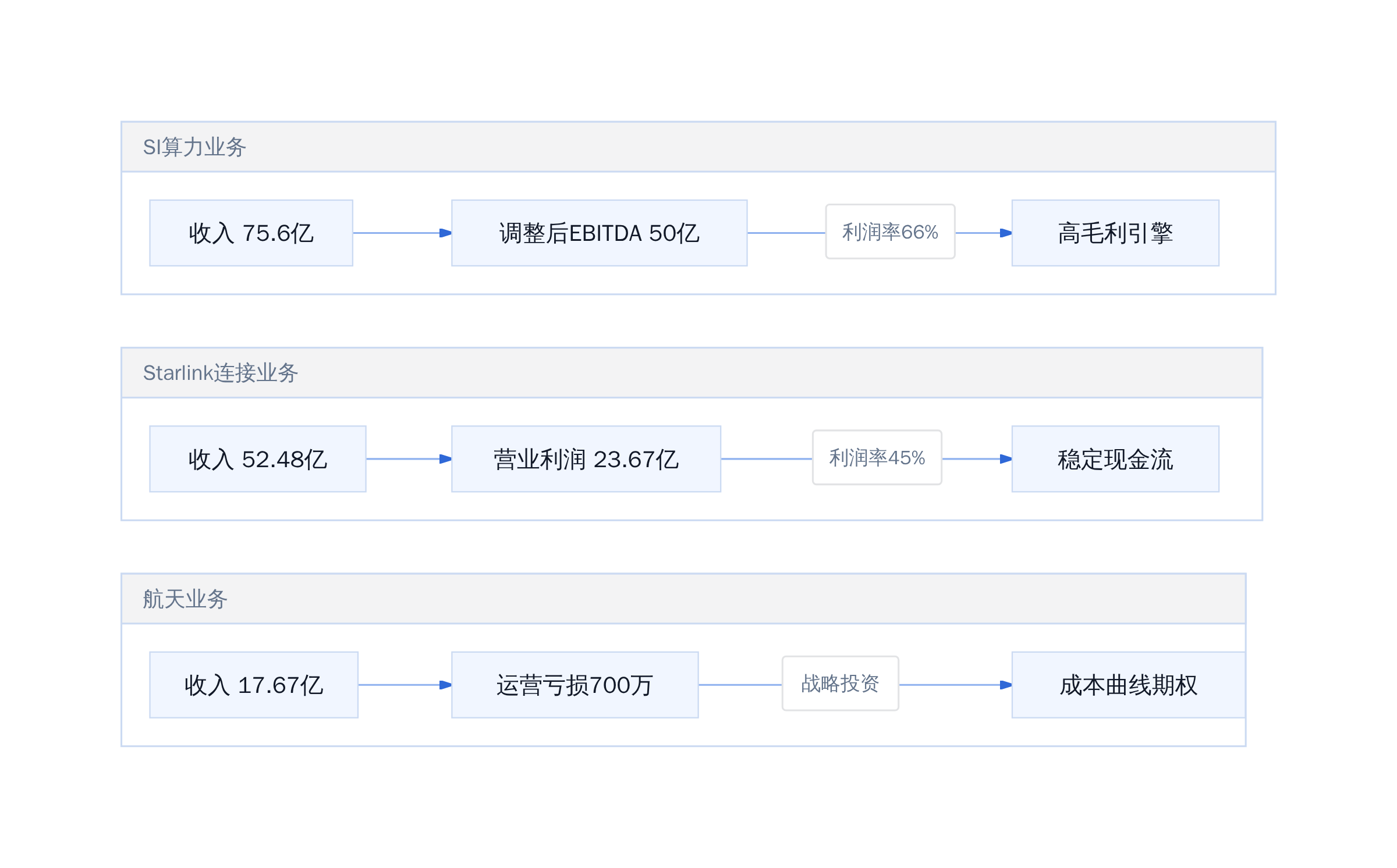
SpaceX Q3 profit structure by business
Compared with the capital-intensive nature of rocket launch, compute rental is closer to the cloud provider model: after a one-time heavy asset investment, marginal cost approaches zero. That explains why SI added USD 5 billion in revenue in a single quarter while Starlink grew only 22% in the same period.
Wall Street's reaction was direct. After the report, SpaceX stock rose more than 5% after hours. The market began to review the company through the valuation logic of an AI infrastructure company; traditional PS (price-to-sales) multiples are being recalibrated.
What is even sharper: what can save USD 100 million a year is not layoffs but reusable rockets bringing launch costs down.
But the market is keeping a discount. Management's projections go far beyond verifiable guidance: ARR of USD 1 trillion next year, Tesla merger discussions, and revenue of USD 1 trillion by 2030. Whether those narratives pay off depends on two variables: the persistence of compute demand and the pace of Starship mass production. Before judgment, look at how SI's growth flywheel turns.
Behind these numbers is a more notable signal: SI's Q3 operating profit reached USD 431 million, jumping from a USD 1.257 billion loss in Q2. That means compute rental has not only validated the revenue model but also hit the breakeven point of unit economics.
How the AI Compute Business Reached USD 7.56 Billion in a Single Quarter
SpaceX's SI business is essentially “selling compute”. It is not selling rockets or satellite connectivity; it rents data center capacity it builds to large-model companies. The three revenue drivers in Q3 were: activation of newly signed cloud service agreements, the consolidation of the Cursor acquisition, and internal consumption by Grok's in-house models.
Cursor's USD 608 million contribution deserves special attention. After this code completion tool was acquired, its enterprise subscription revenue and API call volume were consolidated into the SI segment. With one acquisition, SpaceX connected the ARR of an AI developer tool into its compute network.
The client list is Anthropic, Google, and Reflection AI. These three correspond to different levels of compute demand: Anthropic trains the Claude family, Google uses compute for Gemini inference, and Reflection AI is a newer large-model company focused on inference optimization. SpaceX did not disclose specific contract amounts, but based on the quarter-over-quarter growth curve, individual large-client contracts should be at the hundreds of millions of dollars scale.
The Compute Ambition Behind COLOSSUS II's Expansion to 1.7 GW
As of the end of Q3, COLOSSUS II's nameplate compute capacity reached 1.7 GW, compared with 1.4 GW at the end of Q2 and 0.6 GW in the same period last year, a very steep growth rate.

Data center expansion is as fast as a rocket launch
What does 1.7 GW mean? Under common industry GPU density estimates, it is roughly equivalent to the power supply requirement for 440,000 Rubin-class chips. That scale exceeds the compute clusters in most single regions of major North American cloud providers.
SpaceX's logic is to transfer “rocket-building capability” to “data center building efficiency.” Rockets can be mass produced, and data center modules can also be deployed modularly. The underlying engineering thinking is the same: standardized components, fast iteration, and lower unit costs.
In Q3, AI compute capex reached USD 16.444 billion, 84% of total spending of USD 19.593 billion. That means the company is betting most new investment on compute infrastructure rather than continuing to expand rocket capacity or the Starlink constellation.
The Profit Inflection of the Compute Rental Model: SI Turned Positive for the First Time in a Quarter
SI's Q3 operating margin was about 5.7% (431 million / 7.56 billion). It is not high, but the direction is right: from -157% in Q2 (a USD 1.257 billion loss / USD 256 million revenue) to positive this quarter, an improvement of more than 160 percentage points.
Several factors shaped this margin:
First, COLOSSUS II entered a scale deployment phase, so depreciation cost per unit of compute declined as installed capacity increased. Second, the high-margin SaaS revenue structure from the Cursor acquisition lifted overall margin. Third, long-term leases provided revenue predictability.
Cumulative SI losses for the first three quarters were still USD 3.295 billion, which means the inflection is at the single-quarter level; full-year profitability still depends on marginal improvement in later quarters.
Note that SI adjusted EBITDA reached USD 5 billion. Excluding stock-based compensation (USD 1.2 billion from the Cursor acquisition), the actual operating profit is thicker than the book number suggests.
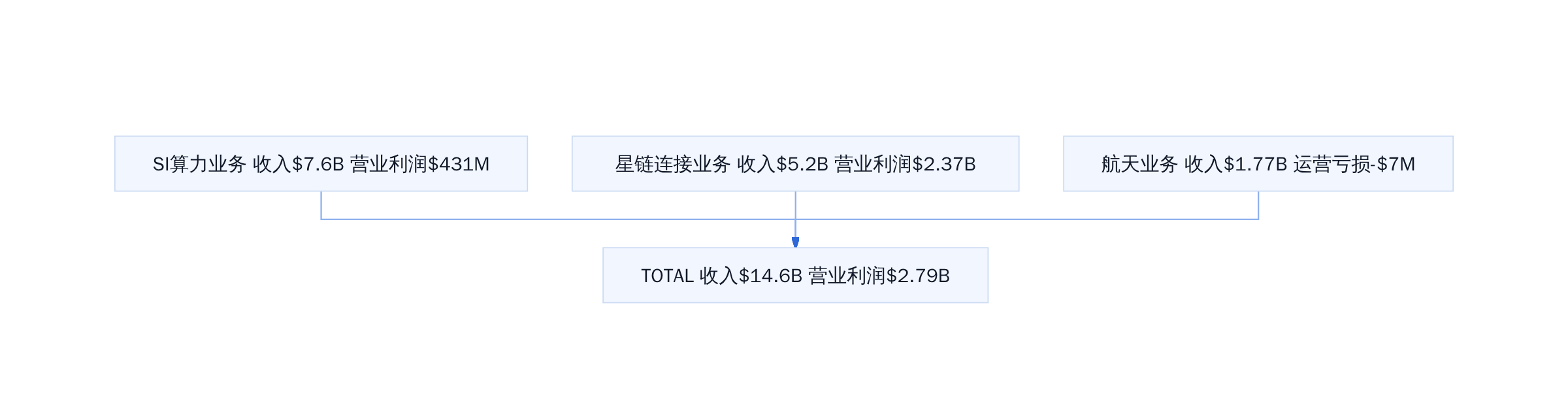
SpaceX Q3 profit contribution structure by business
From the profit structure, Starlink is the current profit engine and SI is the revenue engine. This mismatch between revenue and profit shows a company in transition; the question is which direction will dominate the profit curve over the next three years.
The data is done. SI is the largest revenue source, but an easily overlooked fact behind that sentence: Starlink still contributed USD 5.248 billion and has maintained stable cash inflow for several consecutive quarters. While the market focuses on AI compute, Starlink quietly plays the company's most traditional role: stabilizer.
Starlink Passes 13.6 Million Users; the Connectivity Business Keeps Generating Cash
In Q3, Starlink connectivity revenue was USD 5.248 billion, up 69% year over year and 22% quarter over quarter, with operating profit of USD 2.367 billion, up 99% year over year. These numbers show a simple point: Starlink has moved from a high-growth satellite internet project to a cash cow with continuously increasing profitability.
Passing 13.6 million users is another key milestone. Under the current subscription price structure, ARPU is about USD 30 to 40 a month, meaning Starlink's recurring revenue base is already considerable. More notable is the operating profit growth rate: from operating losses at the start of the year to USD 2.367 billion in operating profit now, the rapid margin improvement is more convincing than the revenue growth rate itself.

The compute-hungry AI business is swallowing everything
Starlink's cash flow meaning goes beyond financial numbers. To support 1.7 GW of compute capacity, SI faces hard constraints on power and bandwidth. Starlink is both a revenue source and a downstream use case for SI infrastructure; the two are physically bound. This synergy was not separately disclosed in the earnings report, but from the business structure, Starlink provides the bandwidth-side anchor for SI expansion.
Starship's 14th Test Flight Reached Orbit; the Space Business Contributed Revenue for the First Time
In Q3, space business revenue was USD 1.767 billion, up only 6% year over year but up 84% quarter over quarter. The source of the growth is clear: Starship's 14th test flight achieved orbital flight for the first time and placed 26 Starlink V3 satellites into the broadband constellation.
This is the watershed where the space business moves from R&D spending to revenue contribution. Previously the space segment lost money every quarter; in Q3 it had an operating loss of USD 7 million, mainly from continued R&D spending, but after Starship reached orbit, the revenue side finally had a substantial positive contribution.
Starship's 15th test flight is planned for next month, with the goal of attempting two-stage rocket recovery in orbit. Two-stage recovery means the launch cost curve can decline further; this is a key precondition for the long-term economic model of the entire space business. Until the cost curve is pushed down, the space business is more like a long-term option than an immediate profit source.

Starlink and SI infrastructure synergy
This picture describes a synergy inside SpaceX that has not been explicitly broken out in the financial report: Starlink's cash flow supports SI capex, and SI's bandwidth needs during construction pull Starlink revenue in return. The binding is deeper than it appears on the surface.
Back to the division of labor among the three businesses: SI provides growth slope, Starlink provides cash flow, and Starship provides the long-term ceiling. This division is the core basis for switching SpaceX's valuation framework. Wall Street previously priced SpaceX mainly by the predictability of launch revenue and Starlink's user growth curve. Now SI introduces a new valuation dimension: recurring revenue from compute rental.
This new dimension means SpaceX is no longer just a rocket company or satellite internet company; it is a comprehensive tech company with hardware manufacturing, energy infrastructure, and a software platform at the same time. Valuation model switching inevitably brings disagreement: some people see the growth potential of 1.7 GW of compute scale, others see the execution risk behind USD 19.6 billion in capex. Disagreement is the premise of rational pricing.
4. Three Questions Behind the Capital Expenditure Surge
Nearly USD 20 Billion of Quarterly Capex: Where Did the Money Go?
Quarterly capex was USD 19.593 billion, with AI-related spending of USD 16.444 billion, or 84%. Cumulative spending in the first three quarters was USD 48.069 billion, with AI-related spending of USD 39.995 billion. The money was not scattered; it was directed at three things.

Compute appetite can never be satisfied
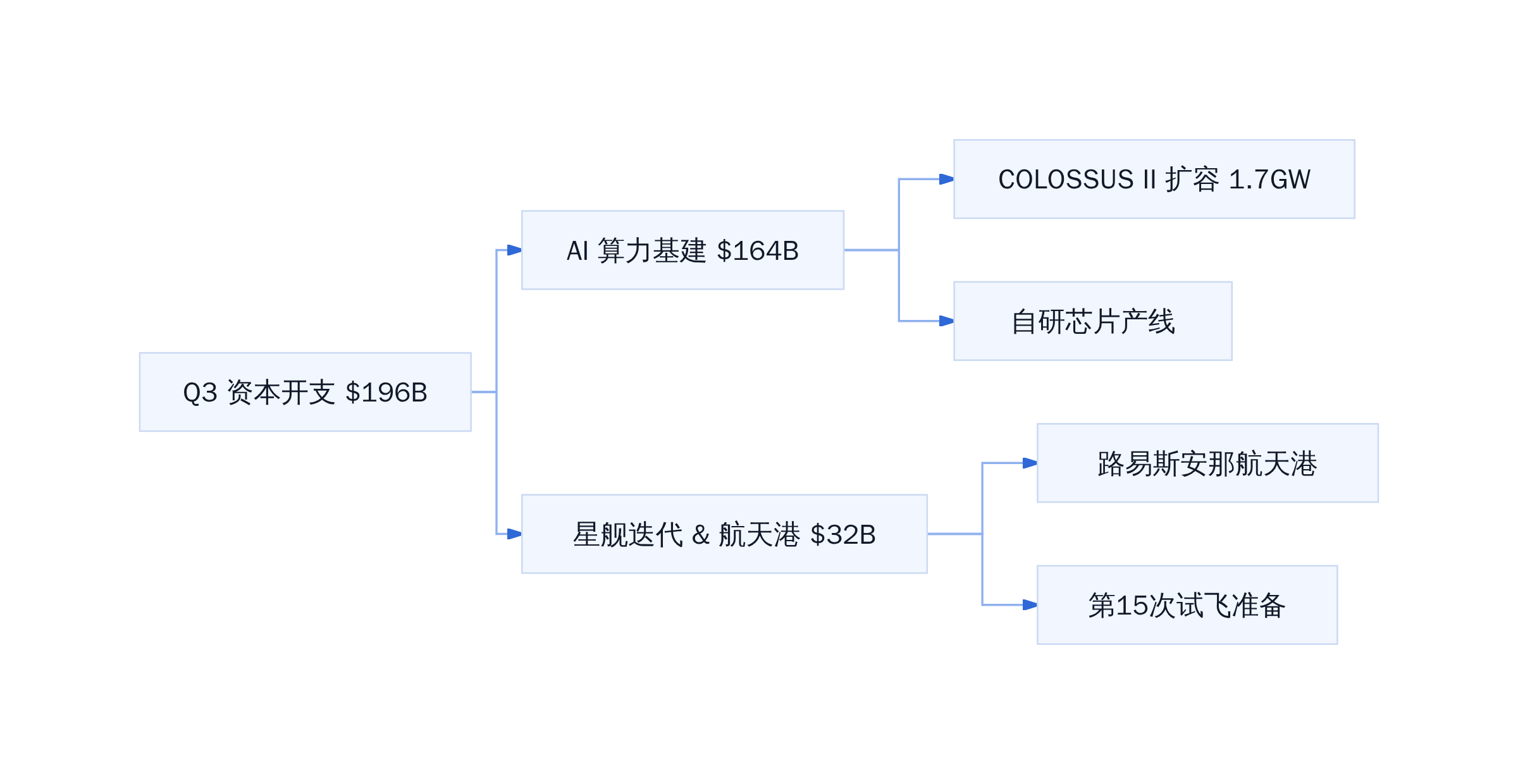
Q3 capex allocation breakdown
Within the USD 16.4 billion of AI investment, the largest share went to COLOSSUS II power and rack capacity expansion, from 1.4 GW at the end of Q2 to 1.7 GW at the end of September. The rest went into self-developed chip production lines and data center construction. This is not buying ready-made GPUs for rental; it is building infrastructure.
Self-Built Chips, Data Centers, and Starship Iteration in Parallel
SpaceX chose a heavier path than cloud providers. Self-built chips mean definition power over compute hardware; self-built data centers mean direct control over PUE, power procurement, and network topology; Starship iteration means pushing launch costs down.
The three lines are interconnected. Starship success lowers launch costs so Starlink V3 satellite batch deployment can keep up; self-built chips in data centers make compute and energy consumption match more precisely; in return, cash flow from AI revenue supports the snowball of capital expenditure.
But pushing all three lines at once places extreme demands on organizational execution. A delay in any one line squeezes resources from the other two.

If three things are done at once, someone has to carry the burden
Can Heavy Capex Create Sustained ROIC Improvement?
This is the core question behind the report. USD 19.6 billion in capex corresponds to USD 14.6 billion in revenue, a CAPEX/Revenue ratio above 134%. That ratio is unsustainable in any traditional industry unless the company is in an early stage of exponential growth and the market is willing to price current investment on the discounted value of future cash flows.
There are three key observation indicators.
First, whether SI gross margin can keep improving from the current roughly 23% (operating profit USD 431 million / revenue USD 7.56 billion, without excluding USD 1.2 billion of Cursor stock compensation). Margin improvement depends on lower unit compute cost from self-built chips, not on continuously adding leverage to buy external GPUs.
Second, utilization of COLOSSUS II's 1.7 GW capacity. If client signings cannot absorb the new capacity, idle capacity will keep eroding ROIC.
Third, the Starship commercialization timeline. The 14th flight reaching orbit is a technical milestone; if the 15th flight achieves two-stage rocket recovery, that would be the real turning point in the cost curve. That turning point did not appear in Q3.
Honestly, SpaceX is trading capex for a long-term option. Whether ROIC improves depends on whether it can push down the option's strike price. In the short term, the market prices the growth slope; in the medium term, the market returns to ROI logic.

Growth stories are easy to tell; return math is hard to calculate
Under the conditions that compute demand persists and COLOSSUS utilization stays above 70%, SpaceX's high-capex strategy has a self-reinforcing logic. Once demand growth slows or Starship iteration is delayed, the model quickly flips to another narrative.
5. Valuation Logic Reconstructed: What Kind of Company Is SpaceX?
From “Launch Company” to a Trinity of “Compute + Connectivity + Space”
For the past decade, the capital market priced SpaceX on a single logic: a PS multiple based on launch frequency and Starlink subscriber numbers. The clearest signal from this report is that formula has failed.
SI is essentially data center rental: revenue recognition is stable and gross margin is far higher than one-off launch services. The connectivity business provides recurring cash flow and broadband network assets with utility-like properties. The space business carries the long-term cost-curve option for deep-space transportation. Together, SpaceX is turning from “a rocket company selling seats” into “a compute landlord collecting rent.” More directly, customers no longer pay for one launch; they pay for every second of compute occupancy.

SpaceX business valuation reconstruction structure
After splitting the businesses, the inputs for discount rates and growth assumptions are completely different. Compute rental should be benchmarked against cloud providers' ARPU model, connectivity against telecom operators' free cash flow discount, and space can only be priced with real options. Mixing them into one total hides the real risk exposure.
The Potential Impact of a Tesla Merger on Valuation
The earnings call mentioned “a committee has been set up to explore a merger with Tesla.” For now this is more of a narrative premium factor than an immediately realized fundamental variable.
The synergy logic is clear: SpaceX's COLOSSUS compute cluster could feed Tesla FSD and Optimus data training needs in return, and Tesla's vertical manufacturing capability could lower rocket and satellite mass production costs. But regulatory review, equity dilution, and friction between two engineering cultures are real discount items.
Honestly, a merger is more like an optional right than an inevitable path. In the short term, SpaceX will continue to finance and expand as an independent entity. Only if merger talks reach a substantive stage will the market recalibrate the valuation anchors of both companies. Before that, treat it as a catalyst for the upper bound of valuation.
Is the Trillion-Dollar Revenue Target Too Aggressive?
Musk's guidance is bold: by the end of 2026, ARR breaks USD 100 billion, with annualized revenue pushing toward USD 1 trillion. Against Q3 quarterly revenue of USD 14.6 billion, a rough annual extrapolation is around USD 50 billion, still about seven times away from a trillion.
Achieving this target requires two hard conditions at the same time. First, SI compute demand must maintain the current quarter-over-quarter growth rate, and new client signings must not break. Second, Starship must achieve high-frequency, low-cost, routine orbital transport, pushing per-launch cost below one-tenth of the current Starship prototype. If either condition is compromised, trillion-dollar revenue is just a slogan from the earnings call.
A more practical lens is the quarterly capex conversion rate. Whether this money converts into verifiable SI revenue and gross margin improvement over the next two quarters is what determines if the valuation premium is realized. Long-term targets are worth watching, but pricing must anchor on near-term execution data.
Now that compute rental revenue is overtaking rocket launch, the company's valuation framework is being rewritten. Suggested leading indicators: SI quarterly renewal rate, Starlink user ARPU changes, and Starship launch turnaround days. If these indicators move up, the narrative stands.
References
[1] Full transcript of SpaceX Q3 2026 earnings call: ARR could reach USD 1 trillion next year; committee set up to explore Tesla merger | US stocks | Anue. https://hao.cnyes.com/post/[REDACTED]
[2] Musk SpaceX Q3 earnings call full transcript: AI compute to 13 GW, 440,000 Rubin chips, Tesla merger discussion, annualized revenue target toward trillion? | Bitcoin Orange Trader (@oragnes) on X. https://x.com/i/article/2112699995946471908
[3] SpaceX turns profitable in Q3, AI business revenue exceeds connectivity business for first time | NetEase subscription. https://www.163.com/dy/article/L9ORVUVK0519QIKK.html
[4] SpaceX's “selling compute” works: Q3 AI business surges 830%, revenue surpasses Starlink for first time | Sina Tech. https://finance.sina.com.cn/tech/roll/2026-10-21/doc-inivyaar5459618.shtml
[5] SpaceX's “selling compute” works: Q3 AI business surges 830%, revenue surpasses Starlink for first time | Eastmoney. https://finance.eastmoney.com/a/202610213902422351.html
[6] Musk's SpaceX Q3 earnings explode, AI becomes the largest revenue source, revenue surges 830% | Carolina | Chinese Headline. https://www.52hrtt.com/klln/n/w/info/D1791623712809
[7] SpaceX Q3 earnings explode, AI becomes the largest revenue source, revenue surges 830% | Wenxuecity. https://www.wenxuecity.com/news/2026/10/20/126811050.html
[8] US Stock Big Data on X: “SpaceX Q3 AI business explodes, revenue surges 830%, profit crushes expectations, capex near USD 20 billion. After the US market close on Tuesday the 20th, SpaceX reported Q3 2026 revenue up 161% year over year to USD 14.58 billion, more than 10% above analyst expectations of about USD 12.8 billion; net profit of about USD 4.4 billion was 2.3 times the expected USD 1.88 billion; adjusted EBITDA surged 306% to USD 8.81 billion, more than 30% above expectations. The most prominent change in this report is that SpaceX's growth engine has further shifted from traditional rocket launch and Starlink connectivity...” / X. https://x.com/StockWe_Com/status/2112692677984882916
More Entry Points
- Archived original: https://tobemagic.github.io/ai-magician-blog/posts/2026/10/22/spacex季度营收146亿ai业务逆袭成第一大收入源/
- WeChat public account: Computer Magician